

The Fixer’s Dilemma
“Is it broken, or did it never work?”


As my career has evolved from taking care of patients to taking care of companies, I am often called in to “fix” broken organizations. Why else would you call the doctor? Applying my hard earned diagnostic acumen, the first step is to understand whether the organization is actually broken and therefore in need of fixing, or as is much more common, it has not actually ever “worked” in the first place and therefore must be built! You’d think this would be easy to determine, like when my children leave a broken plastic toy for a superglue repair on my desk. But with organizations this can be a little bit trickier. Hence, the Fixer’s Dilemma: do you take on the challenge of fixing without knowing if the thing ever worked?
So how do you determine if “it ever worked?” Well, at any point in the past did the organization achieve whatever goals were set out for it? If so, it once worked and needs fixing. It turns out that this question can be frustratingly hard to answer because goals tend to be nonexistent, vague, too numerous, and/or simply drift invisibly over time. As the Venn diagram of company reality starts to spread, the question can become impossible to answer.
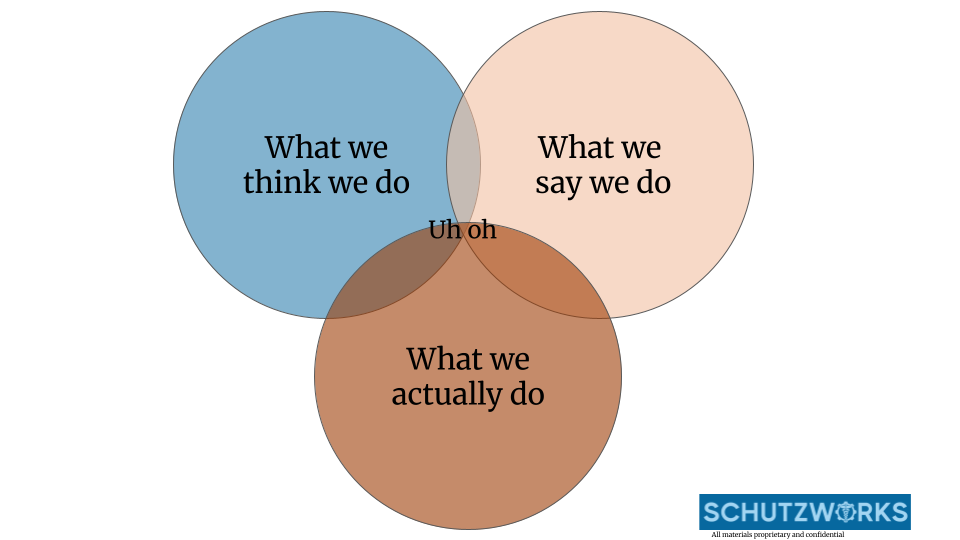
Nevertheless, as the brutal facts of bad performance, usually increasing burn with growth that fails to materialize, obscured by wishful thinking compounded by no clear goals, meet the strong disincentive for failure, leaders can erroneously believe they need to “turn the company around” (i.e. fix it). Advisors & consultants arrive, along with new or replaced executives (with replacing the CEO as a last resort, for the same reason parents loathe to fire all but the worst babysitters, because then you have to watch your own kids!). But remember, if it never worked, it cannot be fixed. It must be built.
As you, [investor, leader, consultant or employee] who may find yourself in this very situation, what should you do?
Understand that building masquerading as fixing is a trap of wildly incorrect expectations. If your backers wrongly assume that the business is “figured out” and just needs to be “rinsed & repeated” or any other ridiculous thoughts only held by people that clearly haven’t ever gone 0->1, then they will be forever hounding you (erroneously) to hurry up and get it right the first time. This impatience stems from a dangerous combination of high expectations, inaccurate information, and the reputation risk for failure. So your first step is to get everyone (including yourself) involved to confront the brutal facts, and reset (lower) expectations (the key to happiness in life as it turns out). The more accurately you can represent reality, the more runway you will have to improve it. Once you have confronted reality, your next step is to codify this understanding in a new set of clear goals, so that you can then go hit them. Much of my writing to date has been focused on building, so if you are really in a building moment, get to it.
For now, let’s assume that the diagnosis is correct: the organization used to work, is actually broken and needs fixing.
Unlike the much sexier company building, a future-oriented activity to accomplish something new, fixing is the art of restoring previous functionality. It is inherently backward looking, negative (because broken = bad), problem-oriented and perhaps most vitally, dependent on a clear end state already proven possible by previous performance. As the Fixer, you must fight the arrow of time, reducing entropy to its previously lower state. Fixing is intensely challenging, yet strangely free of the nagging concern of wondering whether the thing could ever work!
Thus fixing is an intensely creative process, poorly understood relative to building. It cannot be scaled and operationalized in the same way, although cleverly fixing can be converted into building if you have the nerve. The path to “fixed” is rarely as simple as the reverse of the path of breaking it. Knowing the mechanism of breakage is helpful, but you cannot fix something by unbreaking it. Instead, you are going to rapidly cycle between diagnosing the problem with attempts to repair. More iteration!? I am sure you are shocked.
While the key measure of your fix is effectiveness: a durable return of functional performance, debates tend to rightly focus on efficiency: just how much should we spend to fix (vs. replace or forgo)? Questions of repair vs. replacement costs: time, money, talent, opportunity, etc. that can be distracting in building, allow you to understand exactly what problem you are trying to solve. Do you really want the organization fixed vs. your capital returned vs. the mission succeeded regardless of the health of the company? These costs create pressure leading trade-offs, which forces prioritization, providing clarity for goals, allowing for focused attention, which is the most important resource for success.
We all have different calculi for replacing vs. fixing, but as a society we seem to emphasize replacing over fixing, powered partially by false promises about new things combined with the “need” for infinite growth. As resources become scarce, combined with product degradation through “value engineering” or its real name, enshittification, we may just see a return to valuing repair. Especially as the rare, immovable, unique (like people), sentimental or expensive tend to have higher (or undefined) replacement costs, which is why your skills as a fixer are so valuable. Nevertheless, all things will be imperfect, many will break and need to be fixed. Fixing is power, fixing is frustrating, fixing is rewarding, fixing is resilient. But, sadly, not everything can be fixed.
So the next time you are called to solve a problem, remember to first determine if you are dealing with a fix, a new path backward to the future, or a build, solving a problem for the first time. Once you understand where your organization lives on the continuum, you can manage your expectations so you don’t quit and stakeholder expectations so they don’t fire you while you refine your approach to achieve your clarified, desired outcome. As Charles Kettering (last referenced on the Schutzblog in 2011!) reminds us: “a problem well stated is half solved.”